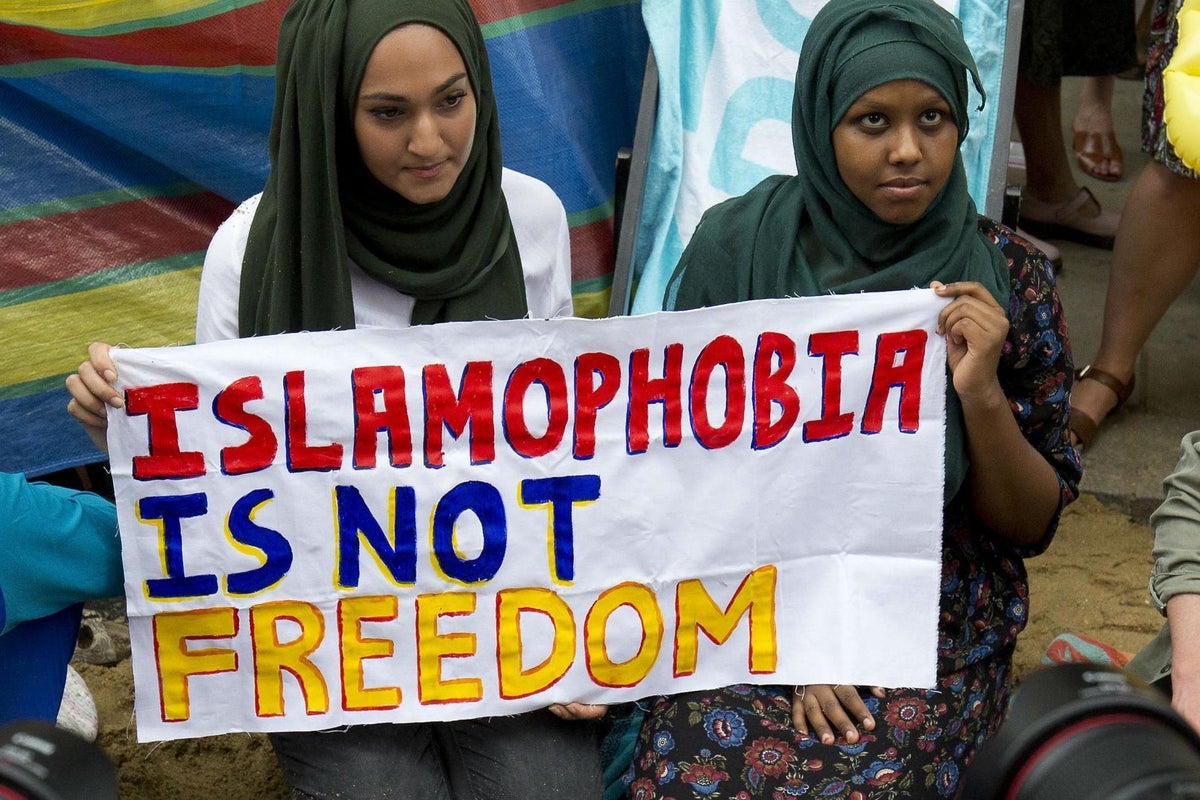
Simply put, Islamophobia is the fear or hatred of Islam and Muslims. But it is a complex issue that has taken on a life of its own through its recent acceleration, often taking on different meanings in different contexts. Over the last decades a few valiant attempts have been made at the policy level to seek a definition of Islamophobia.
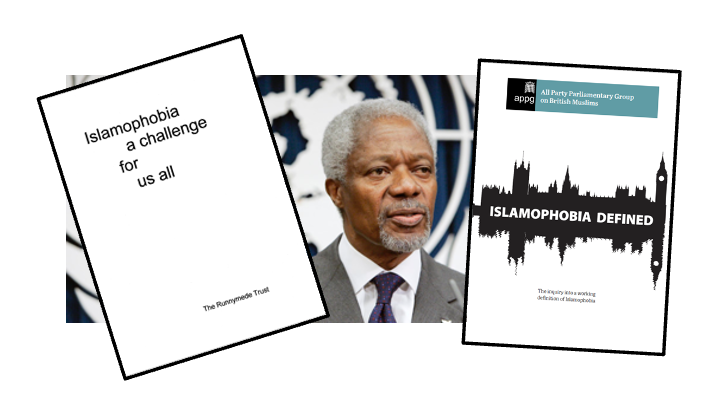
The term Islamophobia itself was first used, in 1923, in the English Journal of Theological Studies, but entered common discourse through the Runnymede Trust’s (UK) 1997 report, Islamophobia: A Challenge for Us All. The report stated: “The term Islamophobia refers to unfounded hostility towards Islam. It refers also to the practical consequences of such hostility in unfair discrimination against Muslim individuals and communities, and to the exclusion of Muslims from mainstream political and social affairs.” The definition emphasised the complexity of the issue and noted that there is a danger in giving it a name in a climate of aggressive political correctness, contentious debates over free speech, and now today with cancel culture.
The term gained a global currency when addressed by then Secretary General of the United Nations, Kofi Annan, in his 2004 conference titled “Confronting Islamophobia”.
In 2018, the All-Party Parliamentary Group on British Muslims recommended that the Parliament of the United Kingdom establish in law a working definition of Islamophobia in their report Islamophobia Defined: Report on an inquiry into a working definition on Islamophobia/anti-Muslim Hatred. The report proposed the following definition: “Islamophobia is rooted in racism and is a type of racism that targets expressions of Muslimness or perceived Muslimness”
To see how it has increased in recent years, we examine Islamophobia as a particular kind of xenophobia - one loaded with political and geopolitical issues.
deteriorating economic situation for many middle- and working-class families; an upsurge in populist, far-right, and fascists political parties; political instability in some Muslim countries and the perceived or real threat of terrorism by Muslim radicals.
However, it is difficult to say if these elements increase Islamophobia or if it is the other way around. There is a clear synergic relationship amongst them.Video from the Council on American-Islamic Relations (CAIR)
In the US, FBI data suggests that there is a base level of Islamophobia that always exists in American society. Instead of seeing Islamophobia as a phenomenon that comes and goes, specific circumstances, such as 9/11 or the 2016 Presidential campaign and election of Donald Trump, trigger spikes in an endemic sentiment. This can be observed through a higher number of incidents which are linked to specific political events in US history. The chart shows the number of anti-Muslim incidents and the number of victims.
Source FBI, Hate Crimes statistics
However, the ‘Mapping Islamophobia’ project, which seeks to visualise Islamophobia and its effects, reveals that Islamophobia is far more complex and pervasive in American public life, taking on many different forms, including those of discrimination, harassment, and violence.
Source: Mapping Islamophobia
The European Union Agency for Fundamental Rights has collected data on discrimination and harassment due to ethnic or immigrant background. It defines four major ethnic and immigration origins: Sub-Saharan Africa, Turkey, North Africa and Asia & Southeast Asia. This suggests that triggering factors for Islamophobia go beyond just religious differences as the majority of the people affected are Muslims.
A 2019 Study by the PEW Research Center focusses on how Muslim are perceived in Europe. In a sample of different European countries, we can see that Eastern European countries have more negative views than Western European countries. But Russia has a surprisingly high positive view percentage (48) - the highest in the survey. However, the point is not just to determine the percentage of people with negative views of Muslims, but to illuminate the very low percentage of people with positive views in certain countries. In Hungary and Slovakia, for instance, less than 20% of its citizens have a positive view of Muslims. Also concerning are the positive view percentages in the Czech Republic, Lithuania, and Poland which are under 30%. Islamophobia indeed runs deep in Europe.
Source: Pew Research Center. Figures express %
Another concerning element in Europe is the number of political parties that are openly anti-Islamic. They have been growing; and in many cases they have been able to use the environment of xenophobia as a platform to increase their constituency. The 2015 refugee crisis provided an opportunity for many of these parties to reach higher audiences through populist methods. In some countries, they have even obtained government positions and/or have high influence on the government.
It is also worth noting how many far-right parties successfully use the European Parliament as a promotion platform.
Here we present the Anti-Islam Political Parties Index (AIPPI) that seeks to determine the capacity of these parties to influence the political agenda. A political party’s ability to influence is measured through five parameters: seats in regional parliaments, being in regional governments, seats in national parliaments, being in national governments and seats in the European parliament. This index considers party performance since 2000.
Sources: Anti-Islam political parties in Europe and our own research
It would be a mistake to assume that Islamophobia is just a Western phenomenon. It is, in fact, quite widespread globally. And since the nature and spectrum of the issues and events that could qualify as islamophobia is wide, we have designed another Index: The Islamophobia Simple Index (ISI). ISI considers several elements: first the actual existence of incidents against Muslims just for being Muslim; second, if these incidents entail physical violence against Muslims; third, if this violence has resulted in serious injuries; fourth, if the violence has caused the death of Muslims; fifth, if the violence has provoked displacements and migration; and sixth, if the violence has been genocidal. Countries where all of these have occurred will have the highest ISI index - that is 6.
Source: List of Islamophobic incidents
The ultimate point is this: Although many xenophobes use fear to fuel islamophobia, globally, Muslims are more the victims than the inciters of violence. In the last 30 years, we have witnessed three major cases of genocide against Muslims.
Chronologically, the first genocide occurred in Bosnia. Between 1992 and 1995 Bosnia was torn in what started as a civil war between Orthodox Serbs, Catholic Croats and Muslim Bosniaks but was gradually revealed to be a mass ethnic cleansing, leading to the Srebrenica massacre - a pervading symbol of such horror.
The casualty figures are based on the research by the ICTY (International Criminal Tribunal for the former Yugoslavia) and the displaced ones by the Borgen Project.
Figures in thousands
More recently, another genocide took place in Myanmar against the Rohingya minority. There is great debate about the real dimension of this genocide, with lower estimates around 13,000 casualties; but according to ASEAN Parliamentarians for Human Rights this figure should be up to 43,700. As for the displaced, Bangladesh has sheltered around 900,000 people, while it is estimated that another 100,000 are confined in Myanmar in camps for internally displaced persons. Many, left uncounted, reside in other neighbouring countries or anywhere they can go (whether or not other governments recognise them as refugees).
Figures in Thousands
In China, the Uyghur people are facing cultural genocide. There are no reliable figures for casualties as China’s opacity makes it difficult to assess what is really happening in Xinjiang.
However, a recent Australian report by the Australian Strategic Policy Institute (ASPI),“Family de-planning: The coercive campaign to drive down indigenous birth-rates in Xinjiang” has revealed that the Chinese Communist Party launched a series of campaigns to reduce fertility in Xinjiang. This has reduced birth-rates of Uyghur and other Xinjiang indigenous communities by 48.74% in the period from 2017 to 2019. Yet, this decline has not affected Han-majority areas. ASPI concludes that “our dataset and analysis offer new evidence that the Chinese government’s actions in Xinjiang likely contravene Clause (d), Article 2 of the 1948 Genocide Convention”, to which China is a party, and constitute “measures intended to prevent births within the group”; although additional research is required to establish whether these actions have been “committed with intent to destroy, in whole or in part the Uyghur people or other minority groups in Xinjiang, and thus constitute genocide.”
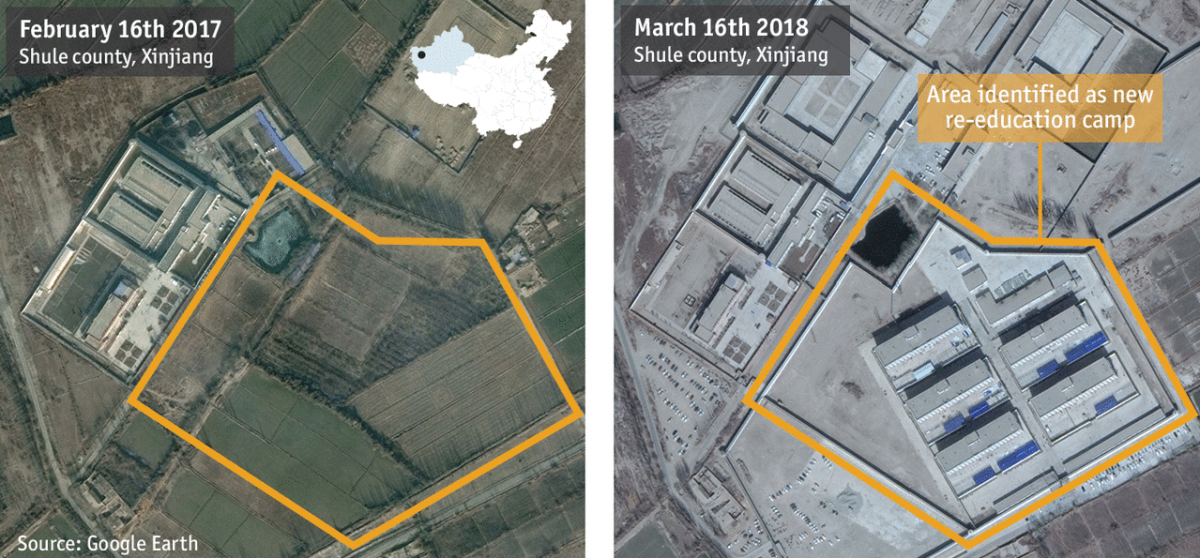
As for displaced people, there are estimations that more than one million Uyghurs have been detained in 85 identified re-education centres. Drone footage of blindfolded people being stacked in a train has given veracity to these claims.
Image from The Economist
Another key locus of Islamophobia comes from the world’s largest minority Muslim population - that of India. India is the third largest Muslim national population in the world, housing over 10% of the world’s Muslims. The story of Islamophobia in India is perhaps as old as the subcontinent itself but has been frequently waxing in waves since independence from the British. Hindu-Muslim riots, and persecution of Muslims has been a regular fixture of recent Indian history - the most obvious example being the 2002 Gujarat riots and killings of Muslims and the ransacking of the Barbari Mosque in 1992.
The rise to power of the BJP, under the premiership of Narendra Modi, who took office in 2014, has seen a sharp rise in Hindu nationalism, which can be correlated with recent spikes in Islamophobia. This is exemplified in the Modi government’s National Register of Citizens (NRC) and the Citizenship Amendment Act (CAA) which both have undertones that legitimise notions of Muslim Indians being second class citizens or even foreign aggressors. The 2020 Covid-19 pandemic has only inflamed tensions where rumours and fake news implicated Islamic practices directly and indirectly in aiding the spread of the virus in India. Mob lynching and rapes paint the individual instances while mass events such as the 2020 Delhi riots (originating as protests against the CAA), where 53 died and over 200 were seriously injured, show the world the brutality of Islamophobia.
Sources: List of Islamophobic incidents and Bridge
What can be done to overcome Islamophobia? The Counter-Islamophobia Kit European project propose a four-step approach:
1. Define Islamophobia
2. Document Islamophobia
3. Deconstruct Islamophobic narratives
4. Reconstruct positive (and realistic) narratives around Muslims.